Fishin' Frenzy: The Real Game vs the Scam Ecosystem Around It
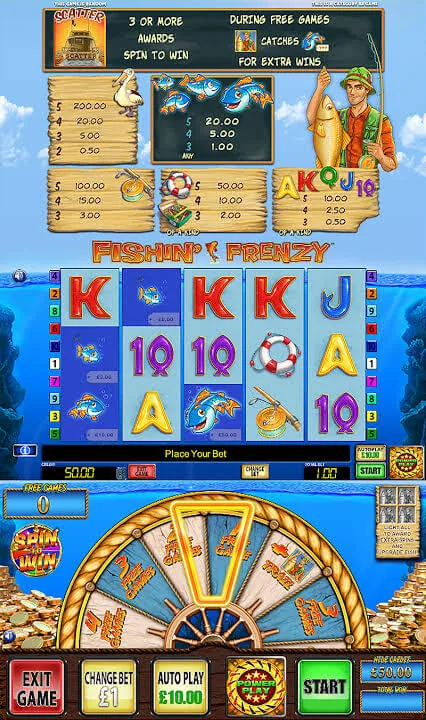
You tap the fisherman icon, the reels spin, three yellow fish land, and a cartoon boat chugs across the screen. Free Spins. The multiplier climbs to 10×. A £2.50 win becomes £25.00. Then the bonus ends, you're back to base game, and fifty spins later you've lost more than you won. That's Fishin' Frenzy—the actual slot from Blueprint Gaming, available on every second UKGC-licensed casino in Britain.
But search «Fishin' Frenzy app» or «free play» on Google, and you'll find a parallel world: TikTok influencers showing impossible £5,000 hits in under a minute, deepfake celebrity endorsements, APK files that ask for your card details, and cloned sites with no UKGC licence number in the footer. The game itself isn't a scam. The ecosystem around it? That's where the fraud lives. Here's how to tell them apart, what the maths actually looks like, and what happens when hype meets a high-volatility RNG.
The First Ten Minutes: What You're Actually Playing
Fishin' Frenzy is a five-reel, ten-payline video slot built by Blueprint Gaming, a UK studio owned by the German supplier Gauselmann Group. It's been around long enough to spawn four sequels (Megaways, The Big Catch, Prize Lines, and Even Bigger Catch), but the original 96.12% RTP version still dominates the lobby pages. The appeal is simple: cartoonish graphics, a Free Spins bonus that multiplies all fish symbols up to 20×, and low minimum stakes—£0.10 on most UKGC sites, capped at £5.00 per spin for players over 25, and £2.00 for anyone aged 18–24 under the stake-cap rules.
When you load the game on a licensed operator—say, a site with a UKGC remote licence number in the footer and GAMSTOP integration—you're connecting to Blueprint's certified RNG server. The mathematics are fixed: high volatility, meaning long stretches of dead spins punctuated by occasional big multipliers in the bonus. The paytable shows a top base-game prize of 5,000× (five wilds), but you'll rarely see it without the Free Spins multiplier stacked on top.
If you see a version claiming 99% RTP, instant withdrawals with no KYC, or a downloadable APK that bypasses the browser, you're not playing the real game. Blueprint doesn't distribute APKs. Google Play and the App Store allow real-money gambling apps from UKGC-licensed operators, but those apps are wrappers that load the same browser-based game—there's no standalone «Fishin' Frenzy original» file.
The First Hour: What the Maths Does to Your Bankroll
High volatility means the RTP of 96.12% is an average over millions of spins, not a promise for your session. In the first hour—say, 300 spins at £0.50 each—you've wagered £150.00. Statistically, you should get back around £144.18, but the distribution is wildly uneven. You might trigger Free Spins twice and walk away with £180.00, or you might see one bonus that pays £12.00 and burn through your deposit.
The game's designed around the Free Spins feature: land three scatter fishermen, get ten free games, and every fish symbol (which normally pays 2× to 50× your line bet) is collected and paid at the end with a random multiplier between 2× and 20×. A single bonus with a 20× multiplier and ten fish symbols can return 200× your total stake. But the base game is a grind—most spins return nothing, and small wins (three low symbols) barely cover the stake.
- Free Spins trigger frequency: roughly 1 in 150–200 spins (high variance, no fixed cycle)
- Base-game hit frequency: around 22% (one win per five spins, often below stake)
- Multiplier distribution in bonus: weighted toward 2×–5×; 15×–20× is rare
- Dead spin streaks: 20–50 consecutive losses are normal, not a malfunction
If you've just started and triggered Free Spins on spin twelve with a 15× multiplier for £60.00, you're ahead of the curve. If you're 200 spins in with one bonus that paid £8.00, you're in the expected volatility range. The «rug pull» isn't rigged RNG—it's the maths catching up. Most players who post «scam» reviews hit this wall in the first hour and assume the game flipped a switch.
The First Week: The Trap Behind the Hype
You've seen the TikTok clips: a £10.00 spin, Free Spins land, the multiplier ticks to 20×, twelve fish symbols flash, and a £2,400 win appears in five seconds. The comments scream «link?» The creator drops an affiliate URL to a site with no UKGC licence, a Curaçao seal that doesn't verify, and a footer that promises «instant crypto withdrawals.» You sign up, deposit £50.00, and the game looks identical—same reels, same boat animation, same paytable. But the bonus triggers every thirty spins and pays £3.00. You're playing a clone.
The scam ecosystem around Fishin' Frenzy is industrial-scale: fake influencer accounts use deepfake audio and stolen footage to push unregulated casinos; APK files branded «Fishin' Frenzy Mod» install malware or phishing forms; Google Search ads promote «free demo» pages that require card details before play; and third-party review sites rank unlicensed operators above legitimate UKGC casinos, because the affiliate commission is higher when there's no regulatory overhead.
| Red Flag | What It Means | Legal Alternative |
|---|---|---|
| No UKGC licence number in footer | Site operates outside UK law; your funds aren't protected | Check the UKGC public register—match the licence to the domain |
| APK download for «original game» | Blueprint doesn't distribute files; this is malware or a clone | Play in-browser on a licensed site, or use the operator's official app |
| Instant withdrawals, no KYC | Unlicensed; when you try to cash out, they'll ghost you | Licensed sites verify age and ID before first withdrawal (24–48 hours) |
| RTP claims above 98% | Blueprint's certified RTP is 96.12%; anything higher is fabricated | Paytable and RTP are visible in the game info panel on UKGC sites |
Here's how to spot the real game in under sixty seconds: open the site footer and look for a UKGC remote licence number (it's a long alphanumeric string starting with 39 or 000). Copy it and search the UKGC public register—if the domain doesn't match the licensee name, close the tab. Then open the game, tap the info button, and check the provider logo (Blueprint Gaming) and the RTP (96.12%). If any of those elements are missing or wrong, you're on a rogue site.
What Changes When You're on a Licensed Site
Every UKGC-licensed operator serving British players is bound by the same set of rules, and they reshape how you interact with the game. The £5.00 stake cap (£2.00 for 18–24-year-olds) means you can't chase a bonus with escalating bets—each spin is capped regardless of your balance. Affordability checks kick in from £150.00 net deposits a month: the operator pulls soft credit-reference data, and if your income or financial profile doesn't support the spend, you'll be asked to provide bank statements or be limited to lower thresholds.
Deposit methods are restricted to debit cards (credit cards were banned for gambling in 2020), PayPal, Apple Pay, Open Banking via Trustly, and paysafecard. The payment must be in your own name—no third-party cards, no joint accounts unless both names are on the casino account. Before your first withdrawal, the operator runs full KYC: proof of ID, proof of address, sometimes a selfie with your documents. This takes 24 to 48 hours, and it's the slowest withdrawal you'll experience. After that, e-wallets clear in a few hours, Faster Payments to your bank take same-day to two working days, and debit card returns take one to three working days.
- GAMSTOP self-exclusion: one registration blocks every UKGC site for six months to five years—no backdoor, no second account
- Deposit limits: operators must offer daily, weekly, and monthly caps; you set them in account settings, and they apply across all games
- Reality checks: a pop-up every hour (or shorter interval if you choose) shows time and net win/loss since login
- Session time-outs: you can set a limit, and the site will log you out automatically when it's reached
Your winnings are tax-free—you keep every pound. The operator pays 40% Remote Gaming Duty on gross profits (raised in April 2026), which is why bonus terms on UKGC sites are tighter than offshore competitors: a typical welcome offer might be «deposit £10.00, get £10.00 bonus, 40× wagering, max bet £5.00 while bonus is active.» That means you'd need to wager £400.00 before converting bonus funds to cash, and every Fishin' Frenzy spin over £5.00 voids the bonus. It's not generous, but it's legal, and the funds are segregated from operator capital.
What Happens When the Hype Outlasts the Bankroll
You've hit a £150.00 win in Free Spins, withdrawn £100.00, and kept £50.00 to play. Fifty spins later, you're down to £12.00, and you haven't seen the fisherman scatters in an hour. The temptation is to redeposit—just £20.00, enough for forty more spins—and the cycle repeats. This is where the game's volatility becomes a trap: high variance slots reward persistence in the maths, but punish it in practice, because most sessions end in loss before the bonus lands.
The scam isn't in the RNG—it's in the expectation created by highlight reels. Every «£5,000 win on Fishin' Frenzy» video compresses a hundred losing sessions into thirty seconds of dopamine, and the algorithm serves it to players mid-session when they're already down. Licensed operators can't legally advertise on social media with win amounts or «easy money» messaging (CAP codes ban it), but influencers on Curaçao-licensed affiliate deals operate outside UK jurisdiction, and their content is designed to make volatility look like a pattern you can crack.
There's no scheme to beat the RNG. Stop-loss strategies (quit after losing £50.00) protect your wallet, not your odds. Betting systems (double your stake after a loss) hit the £5.00 cap in three steps and don't change the maths. The only edge you have is knowing when to stop, and licensed sites give you the tools: set a deposit limit before you start, enable reality checks every thirty minutes, and register with GAMSTOP if you've lost more than you planned twice in a row.
How to Play the Actual Game Without Feeding the Scam
If you want to play Fishin' Frenzy legally in Britain, the path is straightforward: find a UKGC-licensed operator (Betfair, Sky Bet, Grosvenor, William Hill, and dozens of others carry Blueprint's portfolio), verify your age and identity during signup, deposit with a debit card or e-wallet in your own name, and check the game's info panel to confirm you're playing the certified 96.12% RTP version. Demo play is available on most sites, but you'll need to log in to an age-verified account to access it—free play without registration is restricted under UKGC rules.
- Check the UKGC public register: search the site's licence number and confirm the domain matches the licensee name.
- Set deposit and loss limits before you play: daily £20.00, weekly £50.00, or whatever fits your budget—limits apply immediately.
- Ignore influencer links and APK offers: if it's not hosted on a domain with a UKGC licence, it's either a clone or a scam.
- Verify the RTP in-game: open the paytable, scroll to the bottom, and look for «96.12% certified by [testing lab]»—if it's missing, contact support.
- Expect the first withdrawal to take two days: KYC checks are mandatory, and rushing them with «instant payout» promises usually means you're on an unlicensed site.
The game itself is what it is: a high-volatility slot with a nostalgic theme and a bonus round that can return 200× your stake if the multiplier lands high. It's not rigged, but it's not a money printer either. The fraud lives in the margins—fake apps, manipulated demo videos, deepfake endorsements, and offshore clones that look legitimate until you try to withdraw. The UKGC licence is your filter: if the site has one, the game is real, your funds are protected, and your recourse is clear if something goes wrong. If it doesn't, you're gambling with a scammer, and the house always wins that bet.
FAQ
Is Fishin' Frenzy a scam or a legitimate slot?
The game from Blueprint Gaming is legitimate and certified for UKGC-licensed operators. The scam ecosystem exists around it—fake apps, rigged demo videos, unlicensed clones, and influencer links to offshore casinos. If you're playing on a site with a UKGC licence number in the footer, the game is real. Everywhere else, assume it's a clone or a phishing scheme.
Why do I see Fishin' Frenzy APK files and «original app» downloads?
Blueprint Gaming doesn't distribute APK files or standalone apps. Any «Fishin' Frenzy Mod» or «original game» download is either malware, a cloned slot, or a phishing front that will ask for card details. Licensed operators in the UK offer the game in-browser or through their own regulated apps on Google Play and the App Store—there's no separate file to download.
Can I play Fishin' Frenzy for free without signing up?
Demo play is available on most UKGC-licensed sites, but you'll need to log in to an age-verified account to access it. Unregistered free play is restricted under UK rules to prevent underage access. If a site offers instant demo mode with no login, it's either outside UKGC regulation or ignoring the rules—both are red flags.
Why does the game feel rigged after the first big win?
High volatility means long stretches of losses between bonus rounds, and the RTP of 96.12% is an average over millions of spins, not a session guarantee. If you hit Free Spins early and then go 150 spins without another trigger, that's mathematically normal. The RNG isn't rigged—licensed operators use certified servers, and the UKGC audits them—but the variance punishes short-term play. The «rug pull» you're feeling is regression to the mean, not a scam.
How do I check if a Fishin' Frenzy site is legal in the UK?
Open the site footer and find the UKGC remote licence number (starts with 39 or 000). Copy it and search the UKGC public register—if the domain doesn't match the licensee name, close the tab. Then open the game, tap the info button, and verify the provider is Blueprint Gaming and the RTP is 96.12%. If any element is missing or wrong, you're on an unlicensed site. Legal operators also integrate GAMSTOP, enforce £5.00 stake caps (£2.00 for 18–24s), and run KYC checks before the first withdrawal.